The Three-Book Intellectual Project — A Connected Inquiry into Mediation, Mediator Formation and Civilisational Wisdom
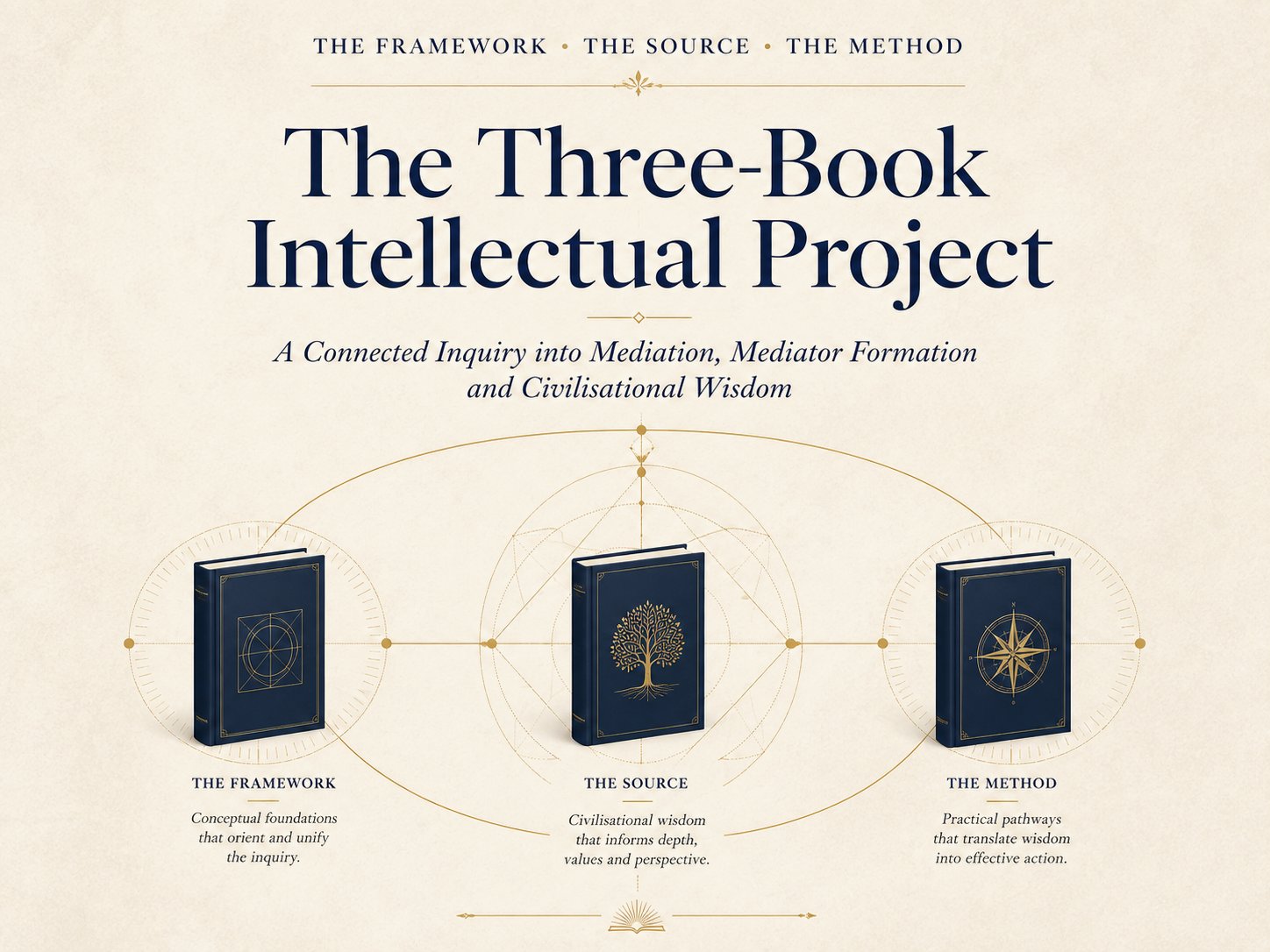
The three books presented here form a connected intellectual project. Each addresses a distinct question arising from the one before it, and together they trace a movement from professional practice, to philosophical foundation, to methodology.
Book One asks: what kind of human and professional competence does mediation require?
Book Two asks: what can the Bhagavad-Gītā contribute to a deeper account of that competence?
Book Three asks: by what disciplined method can wisdom from an ancient civilisational tradition be translated into contemporary professional knowledge?
The resulting sequence may be expressed simply as Framework, Source and Method. The HEART Model provides the professional framework. The Bhagavad-Gītā provides the principal civilisational source examined in the inquiry. Civilisational Synthesis explains the methodology by which the movement from source to professional framework may be undertaken responsibly.
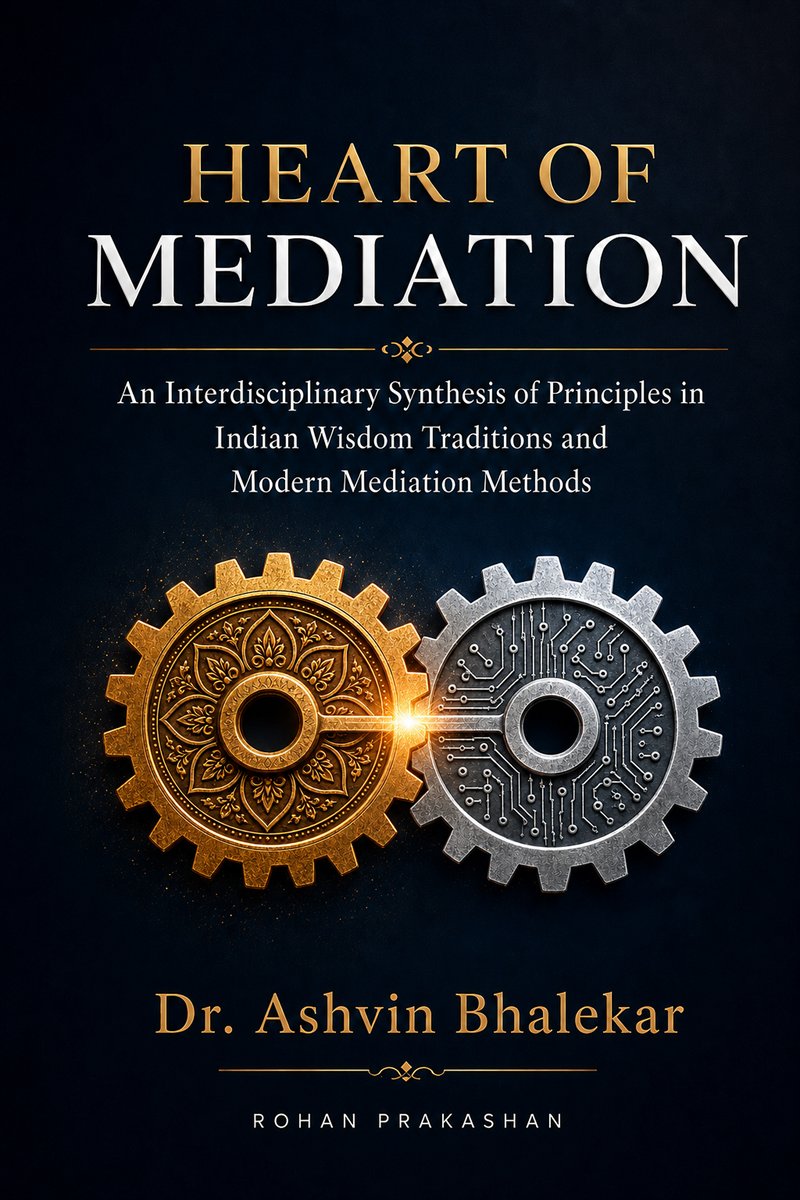
Heart of Mediation
An Interdisciplinary Synthesis of Principles in the Indian Wisdom Traditions and Modern Methods of Mediation.
The principal exposition of the HEART Model, developing mediator competence as an integration of professional skill, ethical responsibility, adaptive judgement, reflective discipline and respect for party autonomy. Its central question: not merely what mediators should do, but what kind of human and professional competence they must progressively develop.
Publication forthcoming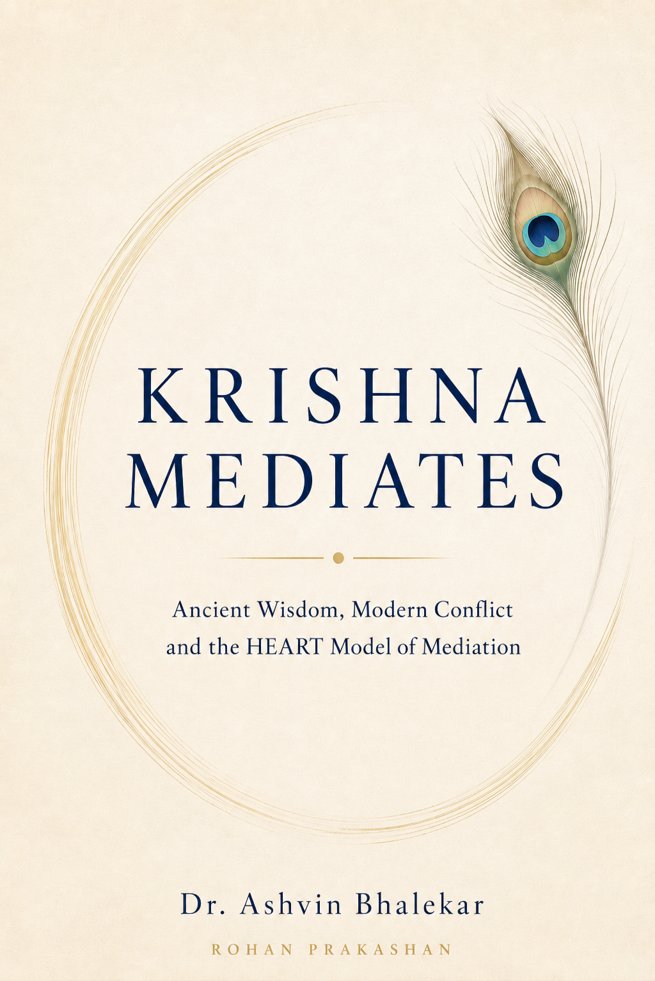
Krishna Mediates
Ancient Wisdom, Modern Conflict and the HEART Model of Mediation.
Turns to the deeper philosophical foundations of HEART, examining the Bhagavad-Gītā as a source of insight for mediation and conflict resolution, and translating its principles into secular and professionally applicable terms, independent of theological belief.
Publication forthcoming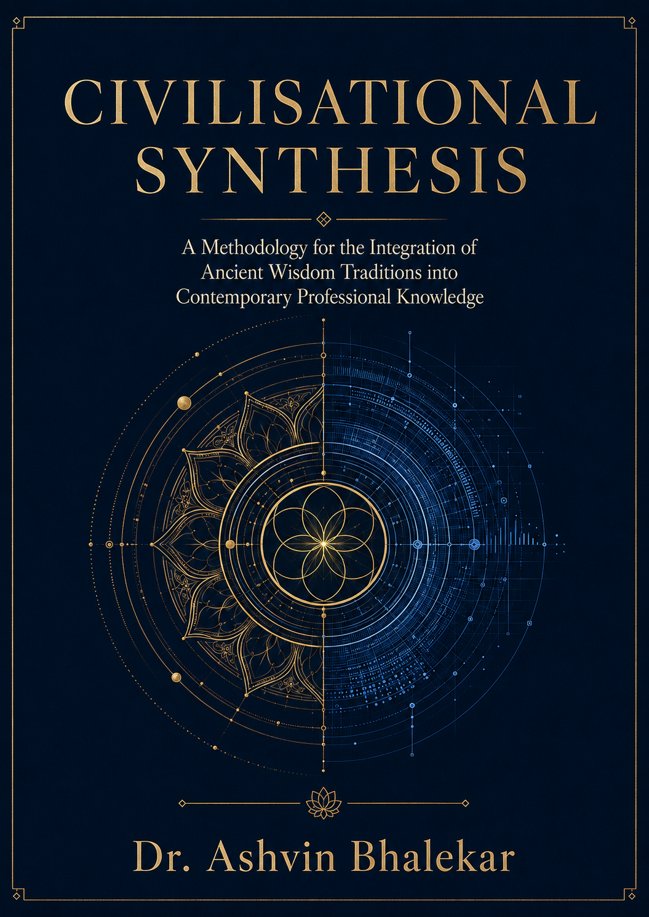
Civilisational Synthesis
A Methodology for the Integration of Ancient Wisdom Traditions into Contemporary Professional Knowledge.
Names, defends and demonstrates Civilisational Synthesis: the disciplined practice of extracting professional and ethical wisdom from a civilisational tradition, translating it into secular and plural language, and integrating it into contemporary professional practice.
Publication forthcomingThe Three Books in Depth
Book One — The Framework: Heart of Mediation — An Interdisciplinary Synthesis of Principles in the Indian Wisdom Traditions and Modern Methods of Mediation

The first book begins with a practical question drawn from mediation practice. Contemporary mediators have access to sophisticated models, procedures and techniques. Yet difficult cases reveal a deeper challenge: technique alone cannot determine how professional judgement should be exercised under pressure.
A mediator may know how to listen, reframe, reality-test, caucus or structure negotiation. The harder questions concern when these interventions should be used, how far they should go, and what ethical limits should guide them. The mediator must also remain steady, adaptive and non-coercive when parties are distressed, entrenched or uncertain. The central inquiry of Book One is therefore: what kind of mediator must one become to hold such a process well?
From this inquiry emerged the HEART Model of Mediation — Holistic, Empowering, Adaptive, Rational and Transformative — presented as a five-dimensional framework for mediator competence and professional judgement. The book places HEART in conversation with facilitative, evaluative, transformative and narrative mediation, while examining the limits of technique-centred practice. It treats mediator formation as an essential part of professional competence: not only skill, but also steadiness, discernment, restraint, role fidelity and freedom from attachment to preferred outcomes.
Its contribution is therefore foundational: it identifies a central problem of mediation practice and develops a coherent framework for addressing it.
Book Two — The Source: Krishna Mediates — Ancient Wisdom, Modern Conflict and the HEART Model of Mediation

If Book One develops the framework, Book Two turns to its philosophical foundations. It examines how selected insights from the Bhagavad-Gītā can illuminate dimensions of mediator competence that contemporary mediation theory has not always articulated with sufficient depth.
The Bhagavad-Gītā is especially relevant because it addresses conflict, counsel, emotional disturbance, self-mastery, discernment, responsibility and action under pressure. Its setting is one of deeply unsettled judgement. Arjuna faces a crisis shaped by fear, attachment, grief and moral uncertainty. Kṛṣṇa responds through sustained counsel aimed not at replacing Arjuna's judgement, but at restoring his capacity to think, choose and act.
The book does not claim that the Bhagavad-Gītā contains modern mediation. Nor does it suggest that religious authority has a place in professional mediation. Its inquiry is narrower and more disciplined: whether carefully interpreted ideas from the text can contribute to a secular, plural and professionally credible understanding of mediator competence.
The governing principle is translation, not transplantation. Ideas such as steadiness, discernment, disciplined action, role fidelity, non-attachment, compassionate understanding and responsibility for wider consequences are examined as resources for professional formation. They are not treated as doctrinal propositions to be imposed upon parties. Book Two therefore provides the deeper philosophical grounding of the HEART Model, examining the sources of its conception of the mediator, the responsible translation of those ideas into professional practice, and whether that translation can withstand serious scholarly scrutiny.
Book Three — The Method: Civilisational Synthesis — A Methodology for the Integration of Ancient Wisdom Traditions into Contemporary Professional Knowledge

Book Three moves beyond mediation to address a broader methodological question: how can insights from ancient civilisational traditions be brought into contemporary professional life without distortion, tokenism, selective borrowing or doctrinal imposition?
Civilisational Synthesis is developed as a disciplined response to this question. It involves identifying relevant ethical and professional insights within a civilisational tradition, translating them into secular and plural language, and integrating them responsibly into contemporary theory, education and institutional practice.
The method responds to a recurring difficulty in professional discourse. Civilisational wisdom is often invoked symbolically, but rarely translated into curriculum, competency standards, assessment, supervision or professional conduct. The challenge is not simply to respect tradition. It is to develop a rigorous method through which traditional insight can become professionally usable knowledge.
Civilisational Synthesis requires more than selecting appealing concepts. It demands careful interpretation of the source, conceptual clarity, secular translatability, plural legitimacy, professional relevance and transparent recognition of limits. A concept that cannot be translated without requiring doctrinal acceptance cannot ordinarily serve as a generally applicable professional competency.
The HEART Model provides the principal worked example of this methodology. The Bhagavad-Gītā is the civilisational source, mediation is the professional field, and HEART is the resulting competency framework. Book Three therefore does not merely restate HEART. It makes explicit the method through which the synthesis was undertaken and considers how the same disciplined approach may be applied to other traditions and professional fields.
From Trilogy to a Wider Inquiry
The foundational trilogy moves from mediator formation to philosophical grounding and then to methodology. A fourth work, presently under development, extends the inquiry beyond the mediation room. It examines the wider institutional and civic consequences of prolonged adversarial conflict.
Its emerging concept is Adversarial Exhaustion: the cumulative psychological, relational, economic, institutional and civic depletion that may arise when adversarial engagement becomes habitual, excessive or prematurely chosen.
This inquiry is not an argument against courts or adjudication. The judiciary remains essential to constitutional governance, protection of rights, authoritative interpretation of law, urgent relief and the determination of disputes that cannot or should not be resolved by agreement. The narrower question is this: what happens when adversarial engagement becomes the default response even where another form of conflict engagement may be more proportionate and appropriate?
The fourth work therefore broadens the scale of the project. The earlier books examine mediator formation, philosophical grounding and the responsible use of civilisational wisdom in professional knowledge. The developing work asks how these insights might also contribute to institutions and public culture in a society facing the accumulated costs of sustained adversarial conflict. As this fourth volume remains under development, it is presented here as an emerging direction of research rather than as part of the completed three-book sequence.
The Larger Project
Across the books, research, articles and institutional work, a larger intellectual and professional framework is taking shape:
- Conflict — must first be understood in its human, relational, structural and legal dimensions.
- Mediation — provides an important consent-based and non-impositional means of engaging conflict.
- HEART — addresses the professional judgement, competence and formation required to conduct mediation responsibly.
- The Bhagavad-Gītā — provides a major civilisational source for exploring questions of judgement, counsel, steadiness, responsibility and action under pressure.
- Civilisational Synthesis — provides the methodology through which insights from wisdom traditions may be translated into secular, plural and professionally usable knowledge.
- HIAM — provides the proposed institutional framework for research, education, training, supervision, assessment and continuing professional development.
- Anant Madhyasthata — provides the wider horizon: the cultivation of an enduring capacity for meaningful, proportionate and responsible conflict engagement.
The books can therefore be understood as stages in a wider and continuing inquiry. They examine how conflict may be understood more deeply, how mediators and other professionals may be formed more responsibly, and how civilisational wisdom may contribute to contemporary professional and institutional life without compromising scholarly rigour, plurality or freedom of judgement.