The HEART Training Architecture — A Progressive Pathway in Knowledge, Practice, Reflection, Supervision and Professional Formation
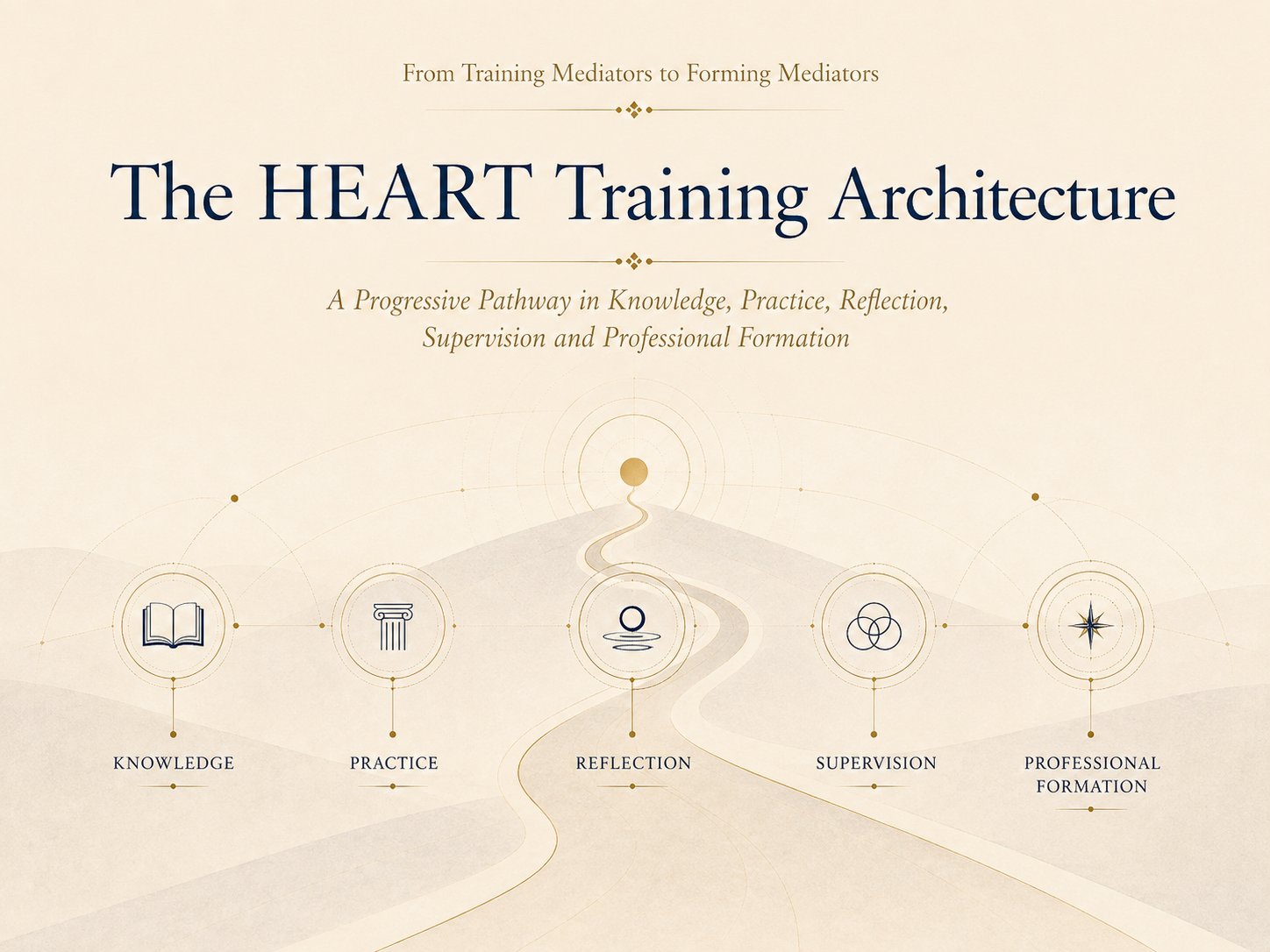
From Knowledge to Professional Formation
The HEART training architecture begins with a simple proposition: a mediation model becomes professionally meaningful only when it can be taught, practised, observed, reflected upon and responsibly assessed.
Mediation training has traditionally and properly emphasised process, communication and negotiation skills. HEART retains these foundations, but adds a further concern: the quality of judgement and professional formation through which those skills are exercised.
This distinction matters. Two mediators may know the same technique and use it very differently. A question may clarify or create pressure. Reality-testing may support informed choice or become indirect persuasion. Silence may create reflective space or amount to passivity. Adaptation may reflect sensitivity or become unprincipled improvisation.
Training must therefore develop more than a range of techniques. It must also strengthen the mediator's capacity to judge when, why and within what limits an intervention should be used.
Three Foundations of Every HEART Programme
The training architecture rests upon three interconnected foundations.
1. Conceptual Literacy
Professional practice requires a clear understanding of the field in which it operates. HEART learners therefore engage with the distinctions between conflict resolution, conflict management and conflict transformation. They also study facilitative, evaluative, transformative and narrative mediation. The aim is to understand where these approaches converge, where they differ, and when different methods may be appropriate.
Learners are also introduced progressively to hybrid dispute-resolution processes and to the legal and institutional settings in which mediation operates.
The purpose is not simply to accumulate theory. Knowledge must mature into judgement. A mediator should be able to understand and explain the professional basis of an intervention rather than rely only upon instinct or habit.
2. Communicative and Ethical Formation
Communication is the mediator's principal professional instrument, but effective communication requires more than technique. HEART develops listening, questioning, reframing, non-verbal awareness and non-coercive communication. It also builds sensitivity to power, culture and trauma.
These capacities are closely connected with professional ethics. Party self-determination, informed consent, impartiality, confidentiality, competence and avoidance of harm are not merely abstract principles. Their meaning is tested most seriously when professional responsibilities come into tension.
A mediator must therefore understand not only the ethical rule, but also how to exercise judgement when impartiality encounters serious power imbalance, confidentiality encounters concerns of safety, or concern for a party begins to threaten that party's autonomy.
3. Professional Sustainability
Professional competence must also be sustainable. HEART therefore includes co-mediation, appropriate documentation, reflective practice, supervision and mediator wellbeing within professional formation.
A mediator who becomes repeatedly absorbed in unresolved emotional involvement, attached to particular outcomes or unable to maintain appropriate professional distance may compromise both personal wellbeing and the quality of practice.
Self-regulation, reflection and professional renewal are therefore treated as dimensions of responsible mediation practice.
Role-Play: Where Knowledge Becomes Practice
The three foundations are brought together through structured role-play.
Mediation cannot be learned through reading and theory alone. Role-play places the learner in situations requiring judgement under realistic pressure. The mediator must listen carefully, respond to emotion, identify changing process needs, recognise power, manage ethical tensions and reality-test without becoming coercive. The learner must also remain aware of personal reactions and assumptions.
At introductory levels, exercises may focus on individual competencies. At more advanced stages, scenarios become increasingly complex, layered and emotionally demanding. Each exercise is followed by observation, structured feedback and reflection. In this way, practice becomes a continuing source of professional learning and development.
A Progressive Six-Tier Pathway
The proposed HEART architecture is developmental rather than uniform. The same five dimensions remain present throughout, but the depth of knowledge, practice, supervision and expected professional maturity progressively increases.
Tier I — Conflict Literacy
The foundational level introduces the nature of conflict, mediation principles and the HEART framework. The emphasis is on recognising conflict more accurately, developing basic process awareness and understanding the ethical foundations of mediation.
Tier II — From Understanding to Judgement
The second level moves beyond conceptual familiarity. Learners begin to use HEART as a framework for deciding what a particular conflict or stage of mediation may require. Comparative study, case analysis and increasingly demanding role plays develop the transition from knowing the framework to applying it.
Tier III — Inner Competence and Professional Practice
At this level, mediator formation becomes explicit. Learners examine not only whether an intervention was technically correct, but what internal conditions shaped its use. Emotional reactivity, attachment to settlement, ethical clarity, impartiality, judgement under pressure and reflective self-awareness become central subjects of professional study. Structured peer consultation and supervision assume increasing importance.
Tier IV — Advanced Practice, Supervision and Training
The fourth level develops practitioners capable not only of mediating, but of contributing to the formation of others. Repeated supervised practice, structured debriefing, assessment and institutional application become increasingly important. Practitioners begin to develop capacities relevant to training, supervision, programme design and professional leadership.
Tier V — Sustained Professional Formation
The fifth tier moves from episodic training towards sustained development. Advanced case analysis, supervised mediation, reflective writing, peer consultation, legal and institutional study, complex process design and research are integrated into a longer programme of professional formation.
Tier VI — Scholar-Practitioner Development
The highest proposed tier is conceived as a future advanced academic and professional pathway for practitioners engaged in research, supervision, advanced practice, institutional design and policy. Any degree-level or university-linked programme would necessarily depend upon appropriate institutional affiliation and applicable academic and regulatory approvals. The architecture therefore describes a developmental horizon, not an assertion of a presently accredited academic award.
The underlying principle across all six tiers remains constant: increasing professional responsibility should be accompanied by increasing depth of knowledge, supervised experience, reflective discipline and demonstrated competence.
Assessing More Than Technique
A distinctive feature of HEART is its attempt to make professional formation observable, discussable and capable of assessment. The assessment architecture considers six closely related domains:
- Holistic Listening — the ability to understand the wider narrative, relational and human context of conflict;
- Empowerment — protection of party autonomy and freedom from settlement pressure;
- Equanimity — steadiness and non-reactivity under pressure;
- Adaptive Design — responsiveness to the actual needs, readiness and circumstances of the parties;
- Rational Discernment — disciplined clarification, appropriate reality-testing and careful distinction between fact, assumption and interpretation;
- Transformative Orientation — sensitivity to dignity, recognition and meaningful changes in the parties' engagement with conflict.
Equanimity is assessed as an important dimension of mediator formation. It does not alter the five-dimensional structure of HEART itself.
The purpose of assessment is developmental, not perfectionistic. It provides a structured language through which a mediator's strengths, vulnerabilities and areas for further development can be identified and discussed.
Supervision as Continuing Formation
HEART does not treat professional development as ending with completion of a training programme. Supervision and peer consultation allow mediators to examine questions that technical assessment alone may not reveal:
- Was I genuinely listening, or simply waiting to move the parties forward?
- Did my reality-testing support informed judgement, or communicate my own preference?
- Was I adapting to the parties, or merely following a predetermined process?
- Did I remain steady when challenged?
- Did my desire to help become pressure to settle?
- Did I recognise an opportunity for dignity or recognition without trying to manufacture reconciliation?
Questions such as these transform reflective practice from a general aspiration into a continuing professional discipline.
From Training Mediators to Forming Mediators
The deeper purpose of the HEART architecture is not to create another catalogue of mediation techniques. It seeks to connect:
The objective is to cultivate mediators who can listen beyond positions, preserve autonomy, remain steady under pressure, adapt intelligently and clarify without coercion. They should also remain attentive to dignity and recognition without imposing reconciliation or preferred outcomes.
When these qualities become part of sustained professional practice, their significance extends beyond individual mediations. They contribute to a professional culture in which understanding is valued alongside settlement, autonomy is protected as a principle, and mediator formation is recognised as a continuing professional responsibility.
This is the larger movement from training mediators to forming mediators — and from individual professional competence towards the wider vision of Sarthak Samwad · Sarthak Samadhan · Anant Madhyasthata.