The HEART Model of Mediation

A Five-Dimensional Framework for Mediator Competence, Professional Judgement and Ethical Practice
Modern mediation has developed sophisticated models, procedures and techniques. Yet difficult cases reveal a deeper professional question. When parties are angry, fearful, entrenched, unequal in power, uncertain about risk, or exhausted by conflict, the mediator's challenge is not simply to select the correct technique. It is to exercise judgement: to know when to listen, when to inquire, when to reality-test, when to slow the process, when to protect autonomy, when to respond to power, and when restraint is more ethical than intervention.
The question beneath the practice is therefore not only "What should the mediator do?" It is also "What kind of mediator must one become in order to hold difficult conflict well?"
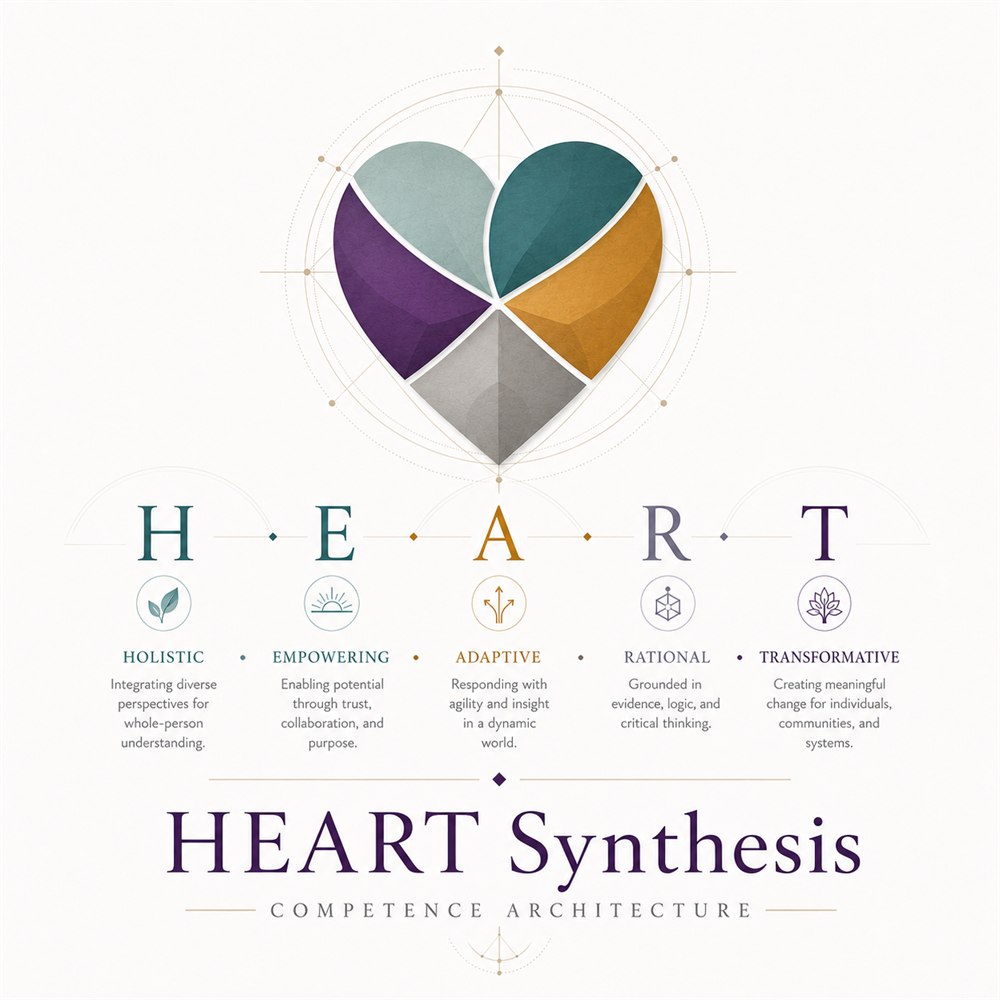
The HEART Model of Mediation arises from that question. It is a wisdom-based and competency-oriented framework. It is designed to strengthen the mediator's capacity to integrate method, ethics and situational discernment without taking ownership of the parties' decisions.
Why HEART, Why Now
Mediation, at its best, is not merely a procedural technique. It is an applied ethics of dialogue, conducted under pressure, in real time, and in imperfect conditions. In these conditions, the mediator's challenge is not only to manage process, but to manage the quality of human engagement without becoming directive, without drifting into advice, and without surrendering the parties' self-determination.
It is here that many mediators encounter a practical difficulty. Contemporary training offers multiple models, each with legitimate strengths. Yet in real practice these models can feel like competing maps. A mediator may begin in a facilitative mode, move toward bounded evaluation under time pressure, attempt a narrative reframe when identity concerns surface, and later seek transformative empowerment when a party collapses into helplessness or despair. None of this is inherently problematic. The difficulty arises when, in the absence of a coherent orientation, such shifts become reactive rather than deliberate. What feels like flexibility can quickly become improvisation under stress.
This unanchored switching of models also generates ethical uncertainty. When does reality-testing become settlement pressure? When does helping become control? When does neutrality become moral silence — or, conversely, moral overreach? When does procedural efficiency begin quietly to erode party autonomy?
What mediators need, especially in difficult and high-stakes cases, is not merely a larger toolbox of techniques, but an integrative framework — the HEART Model of Mediation — that supports professional judgement without reducing practice to scripts.
The Five Dimensions of HEART
H · Holistic
The Holistic dimension requires the mediator to understand conflict in its relevant breadth rather than reducing it immediately to the visible claim. A dispute may contain legal and practical issues, but also questions of meaning, dignity, relationship, recurring interaction, identity, culture, power and institutional context.
Holistic practice does not convert mediation into counselling or therapy. Nor does it require inquiry into every aspect of a party's life. Its discipline is proportionality: the mediator widens the lens only so far as is necessary to understand what is driving the conflict, what is obstructing decision-making, and what the process responsibly needs to address.
The Holistic question: What is the whole conflict that is relevant to this mediation?
E · Empowering
The Empowering dimension protects and strengthens party agency. Conflict can leave people reactive, fearful, confused, fatigued or dependent upon professional authority. The mediator's task is not to decide for them, but to create conditions in which they can think more clearly, speak meaningfully, understand choices and consequences, and make decisions they genuinely own.
Empowerment therefore requires particular vigilance against subtle coercion. Settlement pressure, premature advice, overbearing reality-testing or excessive mediator ownership of the process can weaken the very autonomy mediation is meant to protect.
The governing principle is simple: assistance must not become substitution; guidance must not become pressure.
A · Adaptive
The Adaptive dimension recognises that mediation does not unfold according to a fixed script. Parties differ in readiness, communication style, emotional state, cultural expectations, legal context and power. An intervention that is useful at one stage may be premature or harmful at another.
Adaptiveness is therefore not improvisation. It is reasoned responsiveness. The mediator continuously calibrates process design, sequencing, pacing and intervention to the evolving needs of the conflict while remaining anchored to professional ethics and party autonomy.
The Adaptive question: What does this conflict, at this stage, require from the process?
R · Rational
The Rational dimension concerns disciplined discernment. Conflict often narrows perspective. Assumptions become facts, predictions become certainties, anger may distort risk, and fatigue may create pressure for decisions that have not been adequately considered.
Rational practice helps restore cognitive space. It may involve distinguishing observation from inference, clarifying interests, testing assumptions, examining consequences, exploring alternatives such as BATNA and WATNA, and using reality-testing in a manner that is supportive rather than shaming or coercive.
Rationality in HEART is not cold calculation. It is practical judgement joined with ethical attentiveness. Its purpose is to support informed choice, not to replace the parties' judgement with the mediator's.
The Rational question: What will help the parties see, assess and decide more clearly?
T · Transformative
The Transformative dimension remains open to movement beyond formal settlement where the parties and circumstances permit it. Conflict may sometimes change through greater recognition, restored dignity, clearer responsibility or improved communication. Parties may also develop a different understanding of the conflict and a more constructive capacity to manage future disagreement.
HEART does not require reconciliation, forgiveness or restoration of relationships. Not every conflict calls for these outcomes, and not every party wishes to pursue them. Transformation is therefore a possibility, not an imposed objective. Its nature and extent must always remain with the parties.
Within the HEART Model, transformation may sometimes be modest but still meaningful. Greater clarity, a more respectful separation, restored agency or an improved ability to deal with future disagreement may itself represent significant progress.
The Transformative question: Beyond immediate disposal, is there any responsible possibility for a meaningful shift in understanding, dignity, responsibility or future interaction?
Mediator Formation: The Inner Architecture of Practice
HEART is concerned not only with what a mediator does, but also with the professional qualities that shape those interventions. Techniques such as listening, reframing, questioning, caucusing and reality-testing depend greatly on the mediator's judgement, temperament and ethical discipline.
A mediator may know the correct technique yet apply it poorly when influenced by reactivity, impatience, attachment to settlement, overconfidence or inadequate awareness of power. HEART therefore emphasises steadiness, discernment, role fidelity, reflective awareness, non-attachment to outcome and compassion without over-identification.
This does not require an ideal or flawless mediator. Professional formation is an ongoing process. The aim is to develop a grounded, reflective and capable practitioner who can engage conflict with increasing steadiness, ethical clarity and sound judgement.
Active Impartiality
HEART understands impartiality as an active professional discipline, not as emotional distance or indifference. The mediator must remain free from allegiance to any party, narrative or preferred outcome. At the same time, the mediator remains fully responsible for the integrity of the process, the dignity of the participants, meaningful participation and informed self-determination.
This requires careful balance. Impartiality should not become passivity in the face of coercion, exclusion or serious process imbalance. Equally, concern for fairness should not become advocacy or lead the mediator to substitute personal values for the choices of the parties.
The mediator is therefore non-partisan as to outcome, but actively responsible for the fairness, quality and integrity of the process.
Process Fidelity and Freedom from Outcome Attachment
One of the central disciplines within HEART is the distinction between commitment to the process and attachment to the outcome. The mediator should care deeply about whether the process is fair, clear, non-coercive and professionally sound. But the mediator should not treat settlement as necessary to prove the success of the mediation or the competence of the practitioner.
Freedom from outcome attachment does not mean indifference. It means working actively towards clarity, understanding and constructive engagement while remaining able to respect an informed decision to refuse, pause, continue, separate or seek adjudication.
This discipline protects party self-determination from an important risk in mediation: the gradual conversion of professional assistance into pressure to settle.
Philosophical Grounding and Method
HEART emerged from a sustained engagement between contemporary mediation theory and selected philosophical and psychological insights from the Bhagavad-Gītā. The Gītā is relevant because it addresses conflict, counsel, self-mastery, judgement under pressure, emotional disturbance, duty and discernment.
The model does not claim that the Gītā contains a modern theory of mediation. Nor does it bring religious or doctrinal authority into the mediation room.
The guiding principle is translation, not transplantation. Concepts drawn from tradition become professionally relevant only when they are interpreted carefully and expressed in secular, plural and independently understandable terms.
Civilisational Synthesis describes the wider method through which insights from a traditional source are translated into contemporary professional knowledge in a transparent and accountable manner.
The HEART Definition of Mediation
Mediation may be defined as
A structured, adaptive, consent-based and non-impositional process in which an independent mediator assists the parties and facilitates dialogue to help them recover the capacity to engage and transform their conflict wisely and, where appropriate, reach a voluntary, informed and workable resolution.
The definition retains the established foundations of mediation — consent, independence, party autonomy, dialogue, informed choice and voluntariness — while adding a deliberate emphasis on human capacity, wise conflict engagement and the ethical quality of the process itself.
What HEART Is — and What It Is Not
HEART does not suggest that existing mediation models are outdated or inadequate. It is not a rigid procedural script, a cultural branding exercise or a religious programme. Nor is it intended to improve the moral character of parties. It does not replace legal advice, counselling, therapy or adjudication.
HEART also does not require mediator perfection. Professional competence develops through study, practice, supervision, reflection and experience. The aim is not to create an idealised practitioner, but to provide a coherent framework through which mediator capabilities can be developed, examined and strengthened.
HEART does not treat settlement as the only measure of success. A mediation may result in agreement, partial agreement, improved understanding, better management of continuing disagreement, or a clearer recognition that adjudication is necessary. The essential question is not whether the mediator secured an outcome. It is whether the process was conducted competently, ethically and with full respect for party choice.
From Model to Institution
The HEART Model is intended to move from scholarship into professional practice and formation. This includes teaching, role-play, supervised practice, reflective learning, competency assessment and continuing professional development.
The HEART Institute of Astute Mediation (HIAM) provides the institutional platform for carrying this work forward. As the professional expression of Anant Madhyasthata, HIAM is envisioned as a centre for research, education, training, supervision, publications, professional collaboration and wider conflict literacy.
The relationship is therefore clear: HEART provides the competency framework. HIAM provides the institutional architecture. Anant Madhyasthata provides the wider vision.
At its core, HEART rests on a simple proposition: professional technique becomes more trustworthy when it is supported by sound judgement, ethical discipline and sustained professional formation.
Holistic in understanding. Empowering in relation to agency. Adaptive in method. Rational in judgement. Transformative in possibility.
Five dimensions. One integrated discipline of mediation.